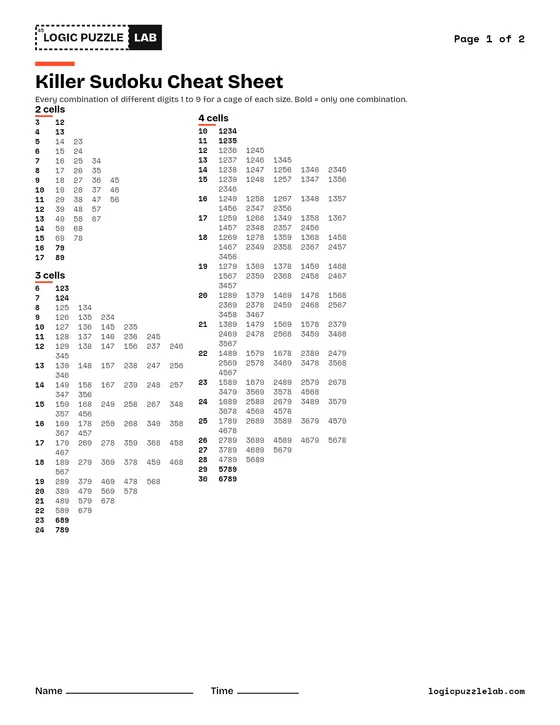
Print the PDF and keep it next to the grid, or leave this page open in a second tab while you play today's killer sudoku. Below is how to read the table, which entries are worth learning by heart, and how to use it on a live puzzle.
How to read the table
Find the block for your cage size, then the row for the cage total. Each entry is a set of digits, not an order: 1 3 under a two-cell 4 means one cell is 1 and the other is 3, either way round. Digits never repeat inside a cage, which is why a two-cell 4 is always 1 and 3 and never 2 and 2.
The range of totals is narrow for every size. Two cells can make 3 to 17, three cells 6 to 24, four cells 10 to 30 and five cells 15 to 35. The busiest totals sit in the middle: a two-cell 9, 10 or 11 has four options each, and a three-cell 14, 15 or 16 has eight. The further a total is from the middle, the fewer options it has and the more it tells you.
The unique combinations worth memorizing
For every cage size from 2 to 7, the two smallest and the two largest totals can each be made only one way. Learn these and you will spot most of a puzzle's easy entry points without checking the sheet.
- 2 cells: 3 = 1+2, 4 = 1+3, 16 = 7+9, 17 = 8+9
- 3 cells: 6 = 1+2+3, 7 = 1+2+4, 23 = 6+8+9, 24 = 7+8+9
- 4 cells: 10 = 1+2+3+4, 11 = 1+2+3+5, 29 = 5+7+8+9, 30 = 6+7+8+9
- 5 cells: 15 = 1+2+3+4+5, 16 = 1+2+3+4+6, 34 = 4+6+7+8+9, 35 = 5+6+7+8+9
- 6 cells: 21, 22, 38 and 39 are unique; 7 cells: 28, 29, 41 and 42
- 8 cells: every total is unique, because exactly one digit is missing and it equals 45 minus the total (an 8-cell 41 has no 4)
Totals that are almost as good
Plenty of cages with two or three options still give away a digit or rule out half the board. A three-cell 8 is 1+2+5 or 1+3+4, so it must contain a 1. A three-cell 22 is 5+8+9 or 6+7+9, so it must contain a 9. A four-cell 12 is 1+2+3+6 or 1+2+4+5, so 1 and 2 are both certain, and a four-cell 28 is 4+7+8+9 or 5+6+8+9, so it holds both 8 and 9.
Some cages tell you what is absent rather than present. A two-cell 5 is 1+4 or 2+3, so neither cell can be 5 or higher. A two-cell 15 is 6+9 or 7+8, so both cells are 6 or more. A three-cell 21 is 4+8+9, 5+7+9 or 6+7+8: no digit is guaranteed, but nothing below 4 can go in.
Using the sheet mid-puzzle
Look up the cage, then strike out any combination that clashes with what is already on the board. If the whole cage sits inside one box and that box already has a 9, every set containing 9 is gone. Take a three-cell 19 in that position: the options are 2+8+9, 3+7+9, 4+6+9, 4+7+8 and 5+6+8, and dropping the three with a 9 leaves 4+7+8 and 5+6+8. The cage must hold an 8.
Placed digits inside the cage shrink it further. If one cell of a three-cell 20 is already 9, the other two cells make 11 without using 9 again: 3+8, 4+7 or 5+6. Pencil in only the digits those pairs allow, and the rest of the row, column or box will often finish the job.
For cages where several digits are ruled out at once, the killer sudoku combinations calculator does the striking out for you: tick what must be in and what can't be, and it lists what is left.
The 45 rule and the sheet together
Every row, column and box holds 1 to 9 once, so each adds up to 45. If the cages lying wholly inside a box total 40 and one cell of the box belongs to a cage that pokes out, that cell is 5. When two or three cells are left over instead of one, their total is still known, and that is where the table earns its place: a leftover pair that must make 4 is 1 and 3.
The sheet also has a mirror built in. The sets of n cells that make a total are the leftovers of the sets of 9 minus n cells that make 45 minus that total. A seven-cell 28 is 1 to 9 without 8 and 9, which is why it matches the two-cell 17. The killer sudoku strategy guide works through the rule of 45 across rows, boxes and groups of houses.
Our own killer puzzles keep every cage to five cells or fewer, so the first four blocks of the table are the ones you will use most. The longer sizes are there for 45-rule leftovers and for puzzles from elsewhere.