Kakuro Cheat Sheet

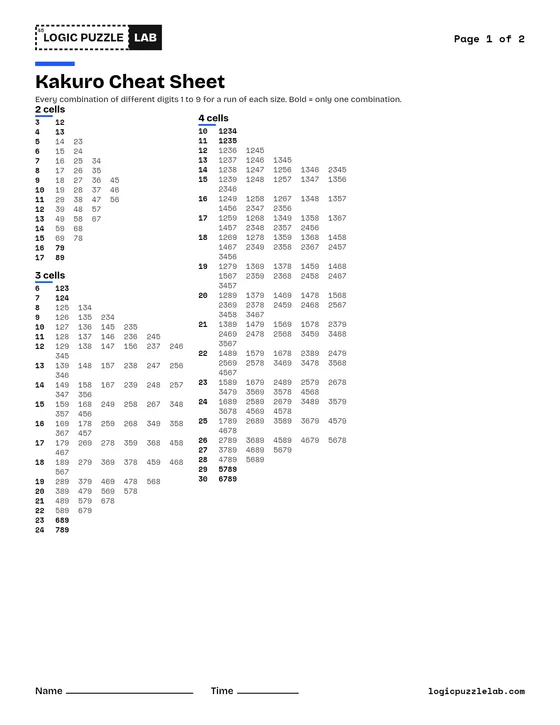
In kakuro, each run of white cells must add up to its clue using different digits from 1 to 9. The table here sorts every possible set by run length, from two cells up to nine, with every clue that run length can carry. Runs that can be filled only one way are highlighted: they are where almost every kakuro starts.

Download the PDF

Every run combination

Sums down the left, the digit sets beside them. Highlighted sums have only one possible combination.

2 cells15 sums

3
12
4
13
5
14 23
6
15 24
7
16 25 34
8
17 26 35
9
18 27 36 45
10
19 28 37 46
11
29 38 47 56
12
39 48 57
13
49 58 67
14
59 68
15
69 78
16
79
17
89

3 cells19 sums

6
123
7
124
8
125 134
9
126 135 234
10
127 136 145 235
11
128 137 146 236 245
12
129 138 147 156 237 246 345
13
139 148 157 238 247 256 346
14
149 158 167 239 248 257 347 356
15
159 168 249 258 267 348 357 456
16
169 178 259 268 349 358 367 457
17
179 269 278 359 368 458 467
18
189 279 369 378 459 468 567
19
289 379 469 478 568
20
389 479 569 578
21
489 579 678
22
589 679
23
689
24
789

4 cells21 sums

10
1234
11
1235
12
1236 1245
13
1237 1246 1345
14
1238 1247 1256 1346 2345
15
1239 1248 1257 1347 1356 2346
16
1249 1258 1267 1348 1357 1456 2347 2356
17
1259 1268 1349 1358 1367 1457 2348 2357 2456
18
1269 1278 1359 1368 1458 1467 2349 2358 2367 2457 3456
19
1279 1369 1378 1459 1468 1567 2359 2368 2458 2467 3457
20
1289 1379 1469 1478 1568 2369 2378 2459 2468 2567 3458 3467
21
1389 1479 1569 1578 2379 2469 2478 2568 3459 3468 3567
22
1489 1579 1678 2389 2479 2569 2578 3469 3478 3568 4567
23
1589 1679 2489 2579 2678 3479 3569 3578 4568
24
1689 2589 2679 3489 3579 3678 4569 4578
25
1789 2689 3589 3679 4579 4678
26
2789 3689 4589 4679 5678
27
3789 4689 5679
28
4789 5689
29
5789
30
6789

5 cells21 sums

15
12345
16
12346
17
12347 12356
18
12348 12357 12456
19
12349 12358 12367 12457 13456
20
12359 12368 12458 12467 13457 23456
21
12369 12378 12459 12468 12567 13458 13467 23457
22
12379 12469 12478 12568 13459 13468 13567 23458 23467
23
12389 12479 12569 12578 13469 13478 13568 14567 23459 23468 23567
24
12489 12579 12678 13479 13569 13578 14568 23469 23478 23568 24567
25
12589 12679 13489 13579 13678 14569 14578 23479 23569 23578 24568 34567
26
12689 13589 13679 14579 14678 23489 23579 23678 24569 24578 34568
27
12789 13689 14589 14679 15678 23589 23679 24579 24678 34569 34578
28
13789 14689 15679 23689 24589 24679 25678 34579 34678
29
14789 15689 23789 24689 25679 34589 34679 35678
30
15789 24789 25689 34689 35679 45678
31
16789 25789 34789 35689 45679
32
26789 35789 45689
33
36789 45789
34
46789
35
56789

6 cells19 sums

21
123456
22
123457
23
123458 123467
24
123459 123468 123567
25
123469 123478 123568 124567
26
123479 123569 123578 124568 134567
27
123489 123579 123678 124569 124578 134568 234567
28
123589 123679 124579 124678 134569 134578 234568
29
123689 124589 124679 125678 134579 134678 234569 234578
30
123789 124689 125679 134589 134679 135678 234579 234678
31
124789 125689 134689 135679 145678 234589 234679 235678
32
125789 134789 135689 145679 234689 235679 245678
33
126789 135789 145689 234789 235689 245679 345678
34
136789 145789 235789 245689 345679
35
146789 236789 245789 345689
36
156789 246789 345789
37
256789 346789
38
356789
39
456789

7 cells15 sums

28
1234567
29
1234568
30
1234569 1234578
31
1234579 1234678
32
1234589 1234679 1235678
33
1234689 1235679 1245678
34
1234789 1235689 1245679 1345678
35
1235789 1245689 1345679 2345678
36
1236789 1245789 1345689 2345679
37
1246789 1345789 2345689
38
1256789 1346789 2345789
39
1356789 2346789
40
1456789 2356789
41
2456789
42
3456789

8 cells9 sums

36
12345678
37
12345679
38
12345689
39
12345789
40
12346789
41
12356789
42
12456789
43
13456789
44
23456789

9 cells1 sums

45
123456789

Print the PDF and slip it inside a puzzle book, or keep the page open beside our kakuro puzzles. The notes below cover reading the table, the entries to memorize, and the habit that turns the sheet from a reference into a solving tool: crossing two runs at once.

Reading the table by run length

Find the run length first, then the clue. Each entry is a set of digits that may sit in any order along the run. A two-cell run of 4 shows only 1 3, because the other way to make 4, 2+2, repeats a digit and is never allowed.

Each run length has a fixed range. Two cells cover 3 to 17, three cells 6 to 24, four cells 10 to 30, and so on up to nine cells, which can only ever make 45. A clue near either end of its range has very few sets, and the highlighted ones have exactly one.

Runs that fill themselves

These are the one-way runs. Learn the two- and three-cell ones first, since short runs turn up all over every board.

  • 2 cells: 3 = 1+2, 4 = 1+3, 16 = 7+9, 17 = 8+9
  • 3 cells: 6 = 1+2+3, 7 = 1+2+4, 23 = 6+8+9, 24 = 7+8+9
  • 4 cells: 10 = 1+2+3+4, 11 = 1+2+3+5, 29 = 5+7+8+9, 30 = 6+7+8+9
  • 5 cells: 15, 16, 34 and 35; 6 cells: 21, 22, 38 and 39; 7 cells: 28, 29, 41 and 42
  • 8 cells: every clue is one way, because a single digit is missing and it equals 45 minus the clue
  • 9 cells: always 1 to 9, total 45

Cross two runs, not one

A white cell belongs to an across run and a down run, and it can only hold a digit both runs allow. This is the move the sheet is really for. Say a cell sits in an across run of 3 in two cells and a down run of 4 in two cells. The first allows 1 and 2, the second 1 and 3, so the cell is 1, the rest of the across run is 2 and the rest of the down run is 3.

The same trick works at the high end. A cell shared by a two-cell 16 (7 and 9) and a three-cell 23 (6, 8 and 9) can only be 9. Place it and the other cell of the 16 is 7, while the rest of the 23 must be 6 and 8 in some order.

Reading the multi-option clues

A clue with two or three sets can still pin down a digit. A three-cell 8 is 1+2+5 or 1+3+4, so the run holds a 1. A four-cell 12 is 1+2+3+6 or 1+2+4+5, so it holds both 1 and 2. A four-cell 28 is 4+7+8+9 or 5+6+8+9, so it holds 8 and 9. When only one cell of the run can take that certain digit, the digit goes there.

Long runs are easier to think about through what they leave out. A seven-cell run of 30 uses every digit except two that add up to 15, so the missing pair is 6 and 9 or 7 and 8. An eight-cell run of 40 is missing only the 5.

Using the sheet as you solve

Every time you place a digit, the run it sits in becomes a shorter run with a smaller clue. Three cells summing to 19 with a 9 already placed leave two cells needing 10 without a 9, so 1+9 drops out and the pair is 2+8, 3+7 or 4+6. Look up the shrunken run instead of the original one and the candidates fall faster.

Kakuro shares this arithmetic with killer sudoku cages, so the killer sudoku cheat sheet is the same table arranged for cages. For the full set of techniques, from first runs to whole-run analysis, see how to solve kakuro, and for the rules themselves, kakuro rules.